


Have you ever experienced recurring pain in the lower right side of your abdomen, particularly around your menstrual period? Perhaps you have already been diagnosed with endometriosis and are wondering whether the condition can affect your appendix. It is an important question because endometriosis can sometimes develop in areas outside the reproductive organs, including parts of the digestive system.
Can endometriosis affect the appendix? Yes. Although uncommon, endometriosis can develop in the appendix, a condition known as appendiceal endometriosis. It may cause recurring abdominal discomfort, pain resembling appendicitis, and occasionally other digestive symptoms. In some women, however, it produces no noticeable symptoms and is only discovered during surgery.
Because appendiceal endometriosis can resemble ordinary appendicitis, identifying the underlying cause may be challenging. In this guide, we will explore how endometriosis affects the appendix, its possible symptoms, diagnostic methods, and available treatment options.
Table of Contents
Can Endometriosis Affect the Appendix?
Yes, endometriosis can affect the appendix, although this is considered an uncommon form of the disease.
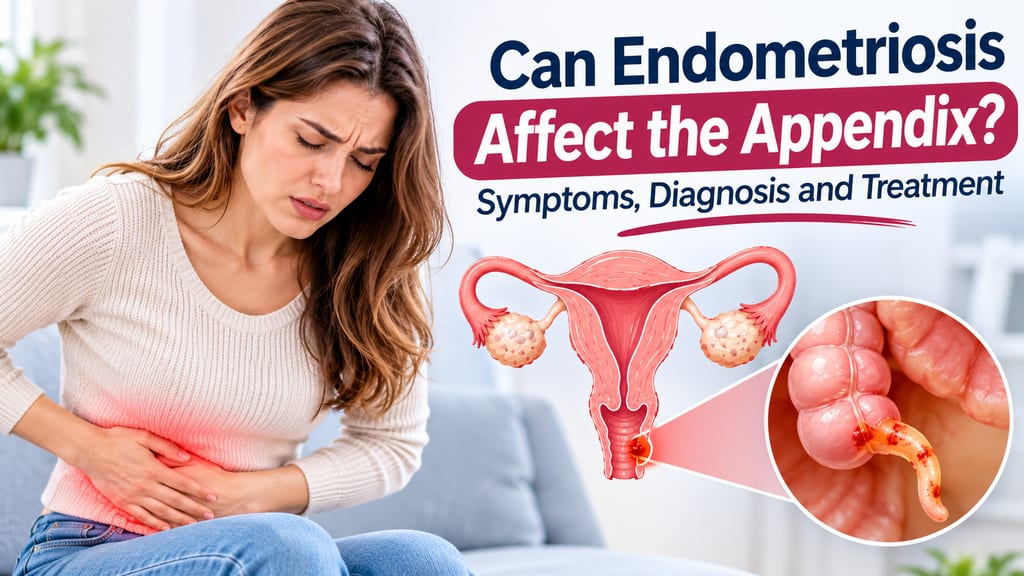
Endometriosis develops when tissue similar to the lining of the uterus grows outside the uterine cavity. These lesions most commonly affect the ovaries, pelvic lining, fallopian tubes, and nearby structures. However, gastrointestinal involvement can also occur.
The appendix is a small, narrow, finger-shaped pouch attached to the beginning of the large intestine, located in the lower right side of the abdomen. When endometriosis develops in or around this structure, it is called appendiceal endometriosis.
Some women experience recurring right-sided abdominal pain, while others develop symptoms that resemble acute appendicitis. The condition may also be discovered unexpectedly when the appendix is removed for another suspected problem.
A 2023 systematic review published in Diagnostics, titled Appendiceal Endometriosis: A Comprehensive Review of the Literature, examined 75 studies involving this uncommon condition.
The review found that appendiceal endometriosis could be found incidentally during gynecological surgery and could also present with symptoms resembling appendicitis.
This is important because it demonstrates that endometriosis is not limited to the ovaries or the more commonly affected pelvic structures.
You can read the complete scientific review of appendiceal endometriosis for additional clinical information.
What Is Appendiceal Endometriosis?
Appendiceal endometriosis occurs when tissue similar to the uterine lining develops within the appendix or its surrounding tissues.
Unlike ordinary appendicitis, which typically involves inflammation and infection of the appendix, appendiceal endometriosis involves endometriotic tissue affecting the appendiceal wall or nearby structures.
These lesions may be located in different layers of the appendix, including the muscular wall and outer surface. Depending on their location and extent, they may contribute to inflammation, fibrosis, adhesions, or changes in the appendix.
One particularly challenging aspect is that the condition does not always produce obvious symptoms.
Some women discover appendiceal endometriosis only after undergoing an appendectomy, when the removed tissue is examined under a microscope.
How Does Endometriosis Develop in the Appendix?
Researchers have not established one definitive explanation for why endometriosis develops in the appendix.
Several theories have been proposed, including retrograde menstruation, movement of endometrial-like cells through the abdominal cavity, and changes in the surrounding tissues.
One possible explanation involves retrograde menstruation, which occurs when menstrual blood travels backward through the fallopian tubes into the pelvic cavity. Endometrial-like cells may then attach to surrounding structures.
However, this theory does not explain every case of endometriosis, and the precise mechanism behind appendiceal involvement remains uncertain.
Researchers have also investigated possible relationships between appendiceal endometriosis and ovarian endometriomas or other forms of pelvic disease.
A 2024 retrospective cohort study involving 460 patients found that appendiceal endometriosis was present in 2.8% of the studied group. The researchers also identified associations with ovarian and bladder endometriosis.
These results suggest that appendiceal involvement may sometimes occur alongside endometriosis affecting other pelvic structures.
What Are the Symptoms of Appendix Endometriosis?
The symptoms of appendiceal endometriosis can vary significantly.
Some women experience no noticeable problems, while others develop recurring abdominal pain or symptoms that resemble an inflamed appendix.
The location of the lesions, the degree of inflammation, and whether other pelvic organs are affected may influence how symptoms develop.
Right Lower Abdominal Pain
One of the most frequently reported symptoms is pain in the lower right side of the abdomen.
This is where the appendix is located, so irritation or inflammation involving this structure can produce localized discomfort.
The pain may feel:
- Sharp or stabbing.
- Dull and persistent.
- Similar to menstrual cramps.
- Worse when moving, coughing, or applying pressure.
- Intermittent or recurring.
Some women initially mistake this discomfort for ordinary menstrual cramps, digestive problems, or ovarian pain.
However, right-sided abdominal pain can have many different causes. Its location alone cannot confirm appendiceal endometriosis.
If your pain repeatedly occurs around menstruation, this pattern is worth discussing with a gynecologist.
You can also explore our article about where endometriosis pain can occur throughout the body to understand how the condition may affect different anatomical areas.
Cyclical Pain Around Menstruation
Another possible symptom is recurring abdominal pain that becomes worse before or during menstruation.
Because endometriosis is influenced by hormonal changes, some women notice that their symptoms follow a menstrual pattern.
For example, you might experience discomfort in the lower right abdomen every month, with the pain becoming more noticeable during your period and improving afterward.
However, cyclical pain does not automatically mean that the appendix is affected by endometriosis.
Other forms of pelvic endometriosis, ovarian conditions, bowel disorders, and menstrual-related conditions can produce similar symptoms.
Keeping a record of your pain, menstrual dates, and other symptoms can help your doctor recognize possible patterns.
Nausea, Vomiting, and Digestive Symptoms
Some women with appendiceal endometriosis experience digestive symptoms, particularly when inflammation or irritation affects nearby intestinal structures.
Possible symptoms include:
- Nausea.
- Vomiting.
- Abdominal bloating.
- Changes in bowel movements.
- Constipation.
- Diarrhea.
- Loss of appetite.
These symptoms are not specific to appendiceal endometriosis. They may also occur with ordinary appendicitis, gastrointestinal infections, irritable bowel syndrome, or other digestive conditions.
If you also experience persistent digestive discomfort, read our guide to how endometriosis can cause bowel and stomach problems.
It is important to investigate persistent symptoms rather than assuming that every digestive problem is caused by endometriosis.
Can Endometriosis of the Appendix Cause Appendicitis?
Yes. Appendiceal endometriosis can produce inflammation and symptoms resembling acute appendicitis.
Ordinary appendicitis occurs when the appendix becomes inflamed, often because its opening becomes blocked. It commonly causes abdominal pain that begins near the belly button before moving towards the lower right side.
Appendiceal endometriosis can sometimes produce a similar clinical picture.
The affected appendix may become inflamed or develop changes within its wall. In certain cases, endometriosis may also contribute to narrowing or obstruction of the appendiceal lumen.
This can make it difficult for healthcare professionals to distinguish appendiceal endometriosis from conventional appendicitis based on symptoms alone.
A 2009 case report published in BMJ Case Reports, titled Endometriosis of the Appendix Presenting as Acute Appendicitis, described a patient whose symptoms initially suggested acute appendicitis. The diagnosis was established after histopathological examination of the removed appendix.
The researchers also discussed presentations involving cyclical and chronic right lower abdominal pain.
A more recent 2025 study, published in the Journal of Clinical Medicine, investigated selective appendectomy in patients undergoing minimally invasive surgery for endometriosis. The researchers found histologically confirmed appendiceal endometriosis in 14.41% of their selected surgical cohort.
This percentage should not be interpreted as the prevalence among all women with endometriosis. The participants were specifically selected for appendectomy during endometriosis surgery.
The distinction is important: appendiceal endometriosis can resemble appendicitis, but not everyone experiencing appendicitis-like pain has endometriosis.
If you develop sudden or worsening lower-right abdominal pain, particularly with fever, vomiting, or loss of appetite, seek urgent medical assessment.
How Common Is Appendiceal Endometriosis?
Appendiceal endometriosis is uncommon, but reported rates vary depending on the population being studied and whether the appendix is examined during surgery.
The 2023 systematic review in Diagnostics analyzed 75 studies published between 1975 and 2021.
Among its findings:
- Appendiceal endometriosis was identified incidentally in approximately 7.23% of the gynecological surgery cases included in the review, with a wide range between studies.
- In studies involving women operated on for suspected acute appendicitis, the reported proportion of appendiceal endometriosis was approximately 2.67%.
- The condition was documented in women experiencing right-sided lower abdominal pain, as well as those without obvious appendiceal symptoms.
A separate 2024 cohort study reported a prevalence of 2.8% among 460 selected patients with endometriosis who had no previous appendectomy.
Why do these figures differ?
The answer is that the studies examined different patient groups. Some involved women undergoing general gynecological surgery, while others focused on patients with suspected appendicitis or more extensive endometriosis.
These figures should not be treated as the likelihood that every woman with endometriosis will develop appendiceal disease.
The available evidence confirms that the condition is relatively uncommon, but it may be overlooked when the appendix is not specifically considered during assessment.
Can Appendix Endometriosis Occur With Pelvic or Bowel Endometriosis?
Yes. Appendiceal endometriosis can occur alongside other forms of pelvic or gastrointestinal endometriosis.
The appendix is located near several important structures, including the cecum, small intestine, right ovary, and pelvic lining. Endometriosis may affect several of these areas at the same time.
For example, a woman may have:
- Ovarian endometriomas.
- Deep pelvic endometriosis.
- Bowel endometriosis.
- Adhesions involving nearby organs.
- Appendiceal endometriosis.
The 2024 cohort study mentioned earlier found that ovarian and bladder involvement were more frequent among patients with appendiceal endometriosis than among those without appendiceal involvement.
This suggests that examining the appendix may be relevant in selected patients undergoing surgery for complex endometriosis.
However, having bowel endometriosis does not automatically mean that the appendix is affected.
The rectum and rectosigmoid colon are much more commonly involved in bowel endometriosis. The appendix is a less common location.
Our detailed guide to bowel endometriosis, its symptoms, diagnosis, and treatment explains how endometriosis can involve different sections of the digestive system.
How Is Appendiceal Endometriosis Diagnosed?
Diagnosing appendiceal endometriosis before surgery can be difficult because its symptoms overlap with several abdominal and gynecological conditions.
Your doctor may consider your menstrual history, pain pattern, physical examination, imaging results, and other symptoms when deciding which investigations are necessary.
Ultrasound and Other Imaging Tests
Ultrasound is commonly used when evaluating abdominal and pelvic pain.
Depending on the situation, doctors may recommend abdominal or transvaginal ultrasound to investigate the appendix, ovaries, uterus, and surrounding structures.
Imaging may help identify:
- Signs of an enlarged or inflamed appendix.
- Abnormalities involving the appendix.
- Ovarian endometriomas.
- Deep pelvic endometriosis.
- Other potential causes of lower abdominal pain.
A computed tomography (CT) scan may also be recommended when acute appendicitis is suspected.
Magnetic resonance imaging (MRI) can provide additional information about deep endometriosis and the surrounding pelvic anatomy.
However, appendiceal endometriosis does not always have distinctive imaging features. A scan may suggest appendicitis without identifying endometriosis as the underlying cause.
A normal scan also does not completely exclude endometriosis.
Laparoscopy and Histopathological Examination
Laparoscopy is a minimally invasive surgical procedure that allows a surgeon to examine abdominal and pelvic structures using a small camera.
When endometriosis surgery is already being considered, the surgeon may inspect the appendix as part of the overall evaluation, particularly if the patient has right-sided abdominal pain or the appendix appears abnormal.
If appendiceal removal is clinically appropriate, the procedure is called an appendectomy.
After removal, the appendix can be sent for histopathological examination. A pathologist examines the tissue under a microscope to identify endometrial glands and supporting stroma within the appendiceal wall.
This examination is particularly important because it can confirm appendiceal endometriosis when imaging and surgical appearance alone are inconclusive.
The 2023 systematic review explains that definitive diagnosis is typically established through histopathological examination of the appendix.
Laparoscopy is not required for every woman with endometriosis, and an appendectomy should not automatically be performed simply because someone has the condition.
How Is Appendix Endometriosis Treated?
Treatment depends on the symptoms, location of the lesions, extent of disease, and whether other pelvic organs are affected.
The goal is to manage symptoms, address complications, and develop an appropriate plan for the patient’s overall endometriosis.
When Is an Appendectomy Necessary?
An appendectomy involves surgical removal of the appendix.
It may be recommended when appendicitis is suspected or confirmed, when the appendix appears abnormal during surgery, or when appendiceal endometriosis is considered responsible for persistent symptoms.
In selected patients undergoing laparoscopic endometriosis surgery, appendectomy may be discussed as part of the overall surgical plan.
However, removing the appendix is not necessary for every woman with endometriosis.
The decision should consider:
- Whether the appendix appears abnormal.
- Whether there is recurring right lower abdominal pain.
- Whether appendiceal endometriosis is suspected.
- Whether other pelvic lesions are present.
- Previous abdominal or pelvic surgery.
- The patient’s overall health and treatment goals.
A 2023 review examined the safety of appendectomy performed alongside gynecological procedures. Its findings were generally reassuring, but the available studies were limited and do not establish that routine appendectomy is necessary for everyone.
A later 2025 retrospective cohort also reported favorable outcomes with selective appendectomy in a specialist surgical population.
Importantly, appendectomy treats disease involving the appendix. It does not remove endometriosis affecting other organs or cure endometriosis throughout the body.
Medical Management and Follow-Up
Medical management may be used to control symptoms associated with endometriosis in other pelvic areas.
Depending on your diagnosis and individual circumstances, treatment may include hormonal medication, pain management, and supportive therapies.
However, hormonal treatment does not physically remove an established appendiceal lesion.
When appendiceal endometriosis is confirmed, your healthcare team may recommend further assessment to determine whether other endometriosis lesions are present and whether additional treatment is needed.
Follow-up is important because endometriosis can involve several different structures, even after an affected appendix has been removed.
An individualized approach is therefore more appropriate than focusing only on the appendix.
When Should You Seek Medical Attention?
Right lower abdominal pain should never automatically be attributed to endometriosis.
Appendicitis is a potentially serious medical condition that requires urgent assessment and sometimes surgery.
Seek urgent medical attention if you experience:
- Sudden or worsening pain in the lower right abdomen.
- Pain that begins around the belly button and moves towards the lower right side.
- Abdominal pain accompanied by fever.
- Persistent nausea or vomiting.
- Loss of appetite alongside increasing abdominal pain.
- Severe abdominal tenderness.
- Pain that becomes worse when walking, coughing, or moving.
You should seek emergency help if you develop severe abdominal pain, significant weakness, fainting, or other signs of serious illness.
Other conditions, including ovarian cyst complications, ectopic pregnancy, pelvic inflammatory disease, urinary problems, and gastrointestinal disorders, can produce similar symptoms.
The NHS appendicitis guidance explains why persistent or worsening lower-right abdominal pain needs prompt medical assessment.
Do not wait for your next period to see whether the pain improves when appendicitis is a possibility.
Endometriosis Evaluation and Treatment With Dr. Lucas Minig in Spain
Living with endometriosis can be challenging, particularly when the condition affects more than one pelvic organ or causes persistent abdominal pain.
Dr. Lucas Minig is a gynecologist and gynecologic oncologist based in Valencia, Spain. He specializes in complex gynecological conditions and advanced minimally invasive surgical approaches.

His clinic provides individualized endometriosis evaluation and treatment planning, combining evidence-based medical management with laparoscopic and robotic surgical techniques where clinically appropriate.
For patients with suspected or confirmed complex endometriosis, specialist assessment may consider:
- The location and extent of endometriosis lesions.
- Possible involvement of the bowel, bladder, ovaries, and other pelvic structures.
- The severity and pattern of abdominal or pelvic pain.
- Previous medical or surgical treatments.
- Current and future fertility goals.
- Whether additional surgical expertise is needed.
The clinic also describes multidisciplinary support, including nutritional guidance, psychological support, and fertility-conscious treatment planning.
You can learn more about Dr. Lucas Minig’s specialist endometriosis evaluation and treatment services in Valencia.
When appendiceal endometriosis is suspected, treatment planning may require coordination between gynecological and general or colorectal surgical specialists, depending on the patient’s findings.
Dr. Minig’s expertise in complex gynecological surgery is relevant to the broader endometriosis assessment, although the need for an appendectomy must be evaluated individually rather than assumed to be part of every endometriosis operation.
Minimally Invasive Surgery and International Patient Support
For selected patients, laparoscopic surgery may be used to investigate and treat complex endometriosis.
A minimally invasive approach involves small abdominal incisions through which a camera and specialized surgical instruments are introduced.
The choice of procedure depends on the location of the disease, surrounding anatomy, previous operations, and the expertise required.
Dr. Minig’s clinic accepts international patients and provides consultation options for people considering specialist endometriosis care in Valencia.
You can also explore the clinic’s gynecological surgery services to learn more about its minimally invasive laparoscopic and robotic surgical approaches.
The first step is a proper evaluation of your symptoms and medical history so that the most appropriate treatment pathway can be discussed.
Conclusion
So, can endometriosis affect the appendix? Yes. Although appendiceal endometriosis is uncommon, it can cause recurring right lower abdominal pain, symptoms resembling appendicitis, and occasionally other gastrointestinal complications. Some women have no noticeable symptoms and only receive a diagnosis after undergoing an appendectomy.
Because its symptoms can overlap with ordinary appendicitis and other abdominal conditions, accurate assessment is important. Imaging may help investigate the problem, but histopathological examination of the appendix usually confirms the diagnosis.
If you have recurring right-sided abdominal pain, particularly when it follows your menstrual cycle, discuss your symptoms with a qualified healthcare professional. Seek urgent care for sudden or worsening abdominal pain because appendicitis and other emergencies must not be overlooked. With appropriate evaluation and individualized treatment planning, you can better understand the condition and make informed decisions about your health.
FAQ’s
Can endometriosis grow on the appendix?
Yes. Endometriosis can develop within the wall or on the outer surface of the appendix. This condition is called appendiceal endometriosis. It is uncommon and may cause right lower abdominal pain or symptoms resembling appendicitis. Some cases are discovered incidentally during surgery.
What does appendix endometriosis pain feel like?
Appendiceal endometriosis may cause sharp, dull, or recurring pain in the lower right side of the abdomen. Some women notice that the discomfort becomes worse before or during menstruation. However, similar pain can occur with ordinary appendicitis, ovarian conditions, and other digestive problems.
Can appendiceal endometriosis be mistaken for appendicitis?
Yes. Appendiceal endometriosis can produce inflammation and abdominal pain similar to acute appendicitis. Symptoms and imaging findings may overlap, making the two conditions difficult to distinguish before surgery. Histopathological examination of the removed appendix can establish whether endometriosis is present.
Does appendix endometriosis always require surgery?
No. Treatment depends on symptoms, clinical findings, and whether complications are present. An appendectomy may be recommended for suspected appendicitis, an abnormal appendix, or clinically significant appendiceal disease. Routine appendix removal is not necessary for every woman with endometriosis.
Can you have appendix endometriosis without pelvic endometriosis?
Yes. Although appendiceal endometriosis can occur alongside pelvic or ovarian disease, isolated cases have also been reported. The condition may be discovered during surgery for suspected appendicitis, even when the patient has not previously been diagnosed with pelvic endometriosis.


