

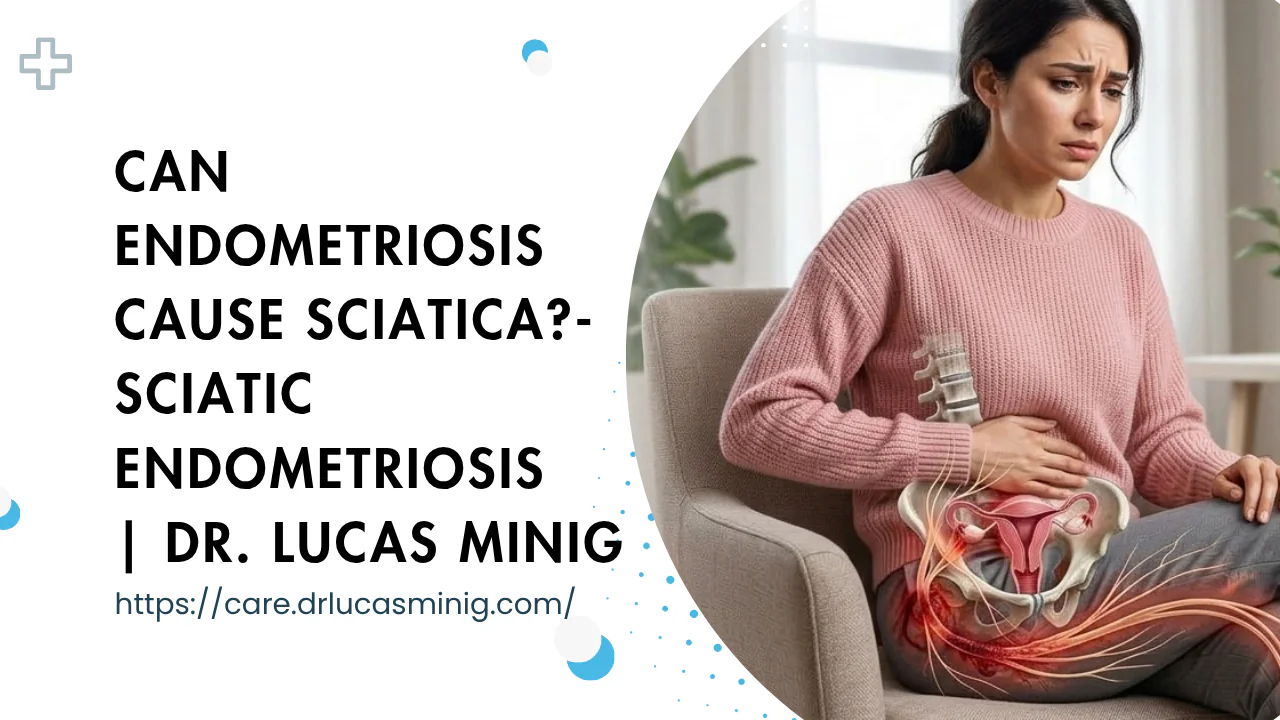
Endometriosis can produce pain that travels from the pelvis or buttock into the leg, creating symptoms that look remarkably similar to ordinary sciatica. In rare cases, endometriosis can actually involve the sciatic nerve itself.
This condition is often called sciatic nerve endometriosis or catamenial sciatica when the symptoms follow the menstrual cycle.
Why does this matter? Because sciatic pain is commonly blamed on a slipped disc, spinal stenosis, or a muscle problem. Sometimes that explanation is correct. But if your pain repeatedly flares before or during your period, especially alongside pelvic pain, numbness, tingling, or leg weakness, endometriosis deserves consideration.
Research and specialist imaging guidelines now recognize pelvic nerve involvement as an important, although uncommon, manifestation of deep endometriosis.
Can endometriosis cause sciatica?
Yes, it can—but true sciatic endometriosis is rare. Endometriosis can cause sciatica-like pain, and in rare cases it can directly affect or surround the sciatic nerve or other pelvic nerves, producing pain that feels remarkably similar to conventional sciatica.
This type of nerve-related pain may travel from the lower back or buttock into the thigh, calf, or foot. One clue can be its relationship with the menstrual cycle, particularly when pain becomes noticeably worse before or during a period. However, not every case follows a textbook pattern.
The Society of Obstetricians and Gynaecologists of Canada includes sciatica among possible endometriosis symptoms and notes that MRI can be used to investigate nerve endometriosis.
So, when should you suspect that your “sciatica” may actually be connected to endometriosis? Let’s look at what the evidence says.
What Is Sciatic Endometriosis?
Sciatic endometriosis occurs when endometriosis affects the sciatic nerve, the major nerve that travels from the lower spine through the buttock and down the leg.
Most endometriosis develops within the pelvis, commonly affecting areas such as the ovaries, pelvic peritoneum and structures around the reproductive organs. Nerve involvement is much less common. A review of reported peripheral nerve cases found that the sacral plexus and sciatic nerve were among the most frequently affected neural sites, although this remains an uncommon manifestation of endometriosis overall.
Why can it feel like ordinary sciatica? Because the sciatic nerve carries sensation and motor signals to much of the lower limb. When that nerve becomes inflamed, compressed, infiltrated, or surrounded by endometriotic tissue and fibrosis, the resulting pain can follow a familiar sciatic pattern.
What Does “Catamenial Sciatica” Mean?
You may come across the term catamenial sciatica in medical literature. “Catamenial” simply means something associated with menstruation.
In this context, catamenial sciatica describes sciatic-type pain that worsens in a predictable relationship with the menstrual cycle. Older case reports and reviews repeatedly describe this cyclic pattern as an important clue to sciatic nerve endometriosis.
That does not mean every woman with period-related leg pain has sciatic endometriosis. It means the timing is worth telling your doctor.

How Can Endometriosis Affect the Sciatic Nerve?
There is no single mechanism that explains every case. Endometriosis can interact with nerves in different ways depending on where the disease is located and how deeply it extends.
Direct Nerve Involvement
In some patients, endometriotic tissue can grow directly around or into the sciatic nerve or nearby nerve structures. This may produce neuropathic symptoms such as burning, electrical or shooting pain, altered sensation and weakness.
Research has documented both perineural and intraneural involvement, meaning endometriosis may occur around a nerve or, in some cases, within the nerve itself.
This is one reason sciatic endometriosis can be difficult to diagnose. The problem is not necessarily sitting in the spine where a typical sciatica workup might first look.
Compression, Inflammation and Surrounding Deep Endometriosis
Endometriosis does not always have to invade the nerve itself to cause nerve symptoms.
Deep infiltrating endometriosis, fibrosis, adhesions, or nearby pelvic lesions may distort or compress neural structures. Chronic inflammation can also contribute to pain signaling and nerve sensitivity. Research into the role of nerves in endometriosis shows that neural pathways are closely involved in the development and maintenance of endometriosis-associated pain.
Think of the nerve like an electrical cable. If tissue grows around the cable, pulls on it, compresses it, or irritates its covering, the signal can become painful or abnormal.
What Does Endometriosis-Related Sciatica Feel Like?
The symptoms can look very similar to conventional sciatica, which is why the condition is sometimes overlooked.
Common Symptoms
Possible symptoms include:
- Pain in the lower back, hip or buttock
- Sharp or shooting pain traveling down the leg
- Burning or electric-like pain
- Tingling or pins-and-needles sensations
- Numbness in part of the leg or foot
- Leg or foot weakness
- Difficulty walking during severe flare-ups
- Pain that becomes worse during menstruation
- Pelvic pain occurring alongside the leg symptoms
Some published cases describe worsening buttock and hip pain during menstruation, followed by neurological findings such as weakness, sensory changes or gait problems.
Neurological Symptoms That Should Not Be Ignored
A little soreness after sitting too long is one thing. Progressive neurological symptoms are another.
Foot drop, increasing leg weakness, significant numbness, difficulty walking, or rapidly worsening neurological symptoms deserve prompt medical assessment. In rare cases, prolonged nerve involvement can result in lasting neurological damage, which is why recognizing the possibility early matters.
New bowel or bladder dysfunction, saddle-area numbness, or severe rapidly progressing weakness also warrants urgent medical evaluation because these symptoms can have several important neurological causes—not only endometriosis.
Is Endometriosis-Related Sciatica Worse During Your Period?
Often, yes—but not always.
Cyclical symptoms are one of the biggest clues described in the literature. A patient may notice that the pain begins shortly before menstruation, peaks during the period, or continues for several days afterward.
One case report described a patient whose hip and buttock pain became severely worse during menstruation, while pelvic MRI ultimately revealed an endometriotic lesion involving the sciatic nerve.
But here is an important detail: the absence of a perfect menstrual pattern does not automatically rule out endometriosis.
Endometriosis-associated nerve pain can become persistent as inflammation, fibrosis, and nerve damage develop. A patient who initially noticed pain only around menstruation may eventually experience symptoms between periods as well.
That is why it helps to track symptoms over several menstrual cycles. Write down when the pain starts, where it travels, whether you experience numbness or weakness, and how those symptoms relate to bleeding.
Patterns that seem confusing in your head often become surprisingly obvious on paper.
Endometriosis Sciatica vs. a Herniated Disc
A herniated disc is a much more common cause of sciatica. So it would be a mistake to assume every case of leg pain in a person with endometriosis comes from endometriosis.
The challenge is identifying the clues that suggest a different cause.
Features That May Raise Suspicion of Endometriosis
Endometriosis-related sciatic pain may deserve consideration when:
- Symptoms repeatedly worsen around menstruation
- You have known or suspected endometriosis
- The pain is accompanied by significant pelvic symptoms
- Standard treatment for presumed spinal sciatica has not helped
- MRI or other spinal investigations do not adequately explain the symptoms
- There is unexplained numbness, weakness, or gait change
A published case described pelvic MRI identifying sciatic nerve endometriosis after other investigations, including pelvic/hip ultrasound, X-rays and CT, had failed to identify the cause.
That does not mean spine imaging is unnecessary. Quite the opposite. A proper assessment may need to consider both spinal and pelvic causes.
The goal is not to choose “back problem” or “endometriosis” too early. The goal is to find the actual source of the pain.

How Is Sciatic Endometriosis Diagnosed?
Diagnosis usually begins with a detailed history rather than a single magic test.
Medical History and Neurological Examination
Your doctor may ask:
- When did the pain start?
- Is it one-sided or both-sided?
- Does it follow your period?
- Where exactly does the pain travel?
- Do you have numbness or tingling?
- Have you noticed weakness?
- Do you have pelvic, bowel, bladder or fertility symptoms?
- Have previous treatments for sciatica worked?
A neurological examination can assess strength, reflexes, sensation, gait and other signs of nerve dysfunction.
The SOGC emphasizes the importance of symptom history and physical examination and recommends referral to an appropriate clinician when the initial assessment is uncertain.
MRI and Specialist Imaging
MRI is particularly important when deep endometriosis or nerve involvement is suspected.
NICE recommends considering specialist transvaginal ultrasound or pelvic MRI when assessing deep endometriosis and says the imaging should be planned and interpreted by professionals with specialist gynecological imaging expertise.
The SOGC similarly notes that MRI may be used to evaluate “nerve endometriosis.”
In suspected sciatic nerve disease, imaging may need to cover the pelvis, lumbosacral region, sciatic notch, buttock and relevant nerve pathways rather than focusing only on the lumbar spine. Some specialized centers may also use advanced techniques such as MR neurography in selected cases.
How Is Sciatic Endometriosis Treated?
Treatment depends on the location and extent of disease, severity of symptoms, neurological findings, fertility plans and previous treatment.
Hormonal and Pain Management
Hormonal treatments can suppress ovarian hormone activity and reduce endometriosis-associated pain for many patients. Options may include combined hormonal contraceptives, progestins, GnRH agonists or GnRH antagonists, depending on individual circumstances. SOGC guidance describes hormonal therapies as part of endometriosis management and also supports individualized, multidisciplinary pain care.
Pain medication and supportive treatments may also have a role.
However, medication does not necessarily remove a lesion that is physically affecting a nerve. Persistent neurological symptoms therefore deserve reassessment rather than indefinite symptom management alone.
Surgery for Nerve-Involving Endometriosis
When significant nerve involvement is confirmed or strongly suspected, surgery may be considered in selected patients.
The surgical objective can include removing endometriotic tissue, releasing compression and preserving nerve function while treating other pelvic disease when necessary. Because pelvic nerve anatomy is complex, these procedures may require careful preoperative imaging and collaboration among gynecology, radiology, neurology, neurosurgery, orthopedics or other specialists depending on the case. Published reports repeatedly emphasize multidisciplinary planning for complex sciatic endometriosis.
Evidence is still limited because sciatic nerve endometriosis is uncommon. However, a 2026 systematic review and meta-analysis covering eight studies and 744 individuals found that laparoscopic nerve decompression was associated with a substantial reduction in sciatic pain, although surgical complications can occur and the evidence base remains relatively specialized.
Surgery, therefore, should not be presented as an automatic answer. It is a decision that should follow proper diagnosis and individualized risk-benefit discussion.
When Should You See an Endometriosis Specialist?
Consider specialist assessment when sciatica does not have a convincing explanation, especially when you also have symptoms suggestive of endometriosis.
This is particularly relevant when pain:
- Comes back around your menstrual cycle
- Travels from the buttock into the leg
- Occurs with severe period pain or pelvic pain
- Is accompanied by numbness or tingling
- Causes weakness or difficulty walking
- Continues despite conventional sciatica treatment
- Occurs in someone who already has diagnosed endometriosis
The key is not to become convinced that endometriosis is definitely the cause. Instead, it is to make sure it is considered when the pattern makes sense.
Endometriosis Care With Dr. Lucas Minig in Valencia, Spain
For patients seeking specialist endometriosis care in Spain, Dr. Lucas Minig provides gynecological evaluation and treatment in Valencia, with services that include assessment of deep endometriosis, advanced pelvic imaging, medical treatment and minimally invasive laparoscopic or robotic surgery when clinically appropriate. His practice also describes multidisciplinary care and support for international patients.
For a patient with suspected nerve involvement, the important question is not simply whether surgery is available. It is whether the diagnosis is clear, whether the nerve is actually affected, and which combination of treatments is appropriate.
That may mean reviewing previous MRI scans, reassessing the menstrual pattern of symptoms, considering specialist pelvic imaging, and involving other specialists when neurological findings are present.
Dr. Minig’s also offers online consultations for patients who cannot immediately travel to Valencia, which can be useful when someone wants an expert review of existing medical records and imaging before planning further care.

Conclusion
So, can endometriosis cause sciatica? Yes. Rarely, endometriosis can involve or affect the sciatic nerve and create genuine sciatic-type pain, numbness, tingling, weakness and even difficulty walking. The strongest clue may be a pattern that repeatedly worsens around menstruation, but the symptoms are not always perfectly cyclical.
Because ordinary spinal sciatica is much more common, the diagnosis requires careful clinical reasoning rather than assumptions. A detailed history, neurological examination and appropriately targeted imaging—particularly specialist MRI when nerve involvement is suspected—can help uncover the cause.
When unexplained leg pain keeps returning, especially alongside symptoms of endometriosis, it is worth looking beyond the spine.
FAQ’s
Can endometriosis cause sciatica in one leg?
Yes. Sciatic endometriosis may affect one side and cause buttock, hip or leg pain along the distribution of the sciatic nerve. Published cases have described predominantly unilateral symptoms, sometimes with numbness or weakness.
What does endometriosis sciatica feel like?
It can feel like classic nerve pain: sharp, shooting, burning or electric pain traveling from the lower back or buttock down the leg. Tingling, numbness, weakness and pain related to menstruation can provide additional clues.
Can an MRI detect sciatic endometriosis?
MRI can help identify deep endometriosis and nerve involvement, particularly when performed and interpreted by specialists familiar with gynecological imaging. However, a normal MRI does not necessarily exclude all endometriosis.
Does endometriosis-related sciatica go away after your period?
It may improve after menstruation in patients with a strongly cyclical pattern, but not everyone experiences complete relief. With ongoing inflammation or nerve involvement, symptoms can become persistent between periods.
Can sciatic endometriosis be treated without surgery?
Sometimes. Hormonal treatment and pain-management strategies may reduce symptoms, but treatment depends on the location and severity of nerve involvement.


